

According to the news story, this $50 find—from a garage sale—was a Van Gogh.
But when I looked at the image, I couldn’t help wrinkling my nose and shaking my head. No. Whatever that was, it wasn’t a Van Gogh.
The next thing that popped into my head as my gaze alternated between the article and what in my opinion was a pretty hideous painting was an intriguing question:
Had Van Gogh ever visited New England?
At first, I stifled both responses. Who was I to question expert opinions on the matter?
But when I realized the Van Gogh Museum was questioning the attribution as well, I probed a little deeper into my first instinctive response to the work.
What was so off about the work? The answers called to mind everything that I’d absorbed about the process of art attribution and authentication while researching my two art theft mysteries: the Celine Skye Psychic Series and Sophie’s Adventures.
At the time, I’d learned about the “connoisseur’s eye,” an astounding and mysterious faculty that enabled art experts to instinctively know whether a work was authentic or not.
Alix London, the amateur sleuth protagonist of the fantastic mystery series co-authored by Aaron Elkins and his wife, Charlotte, possesses this faculty. But so apparently do art dealers like Philip Mould whose television docu-series with BBC journalist Fiona Bruce, Fake or Fortune, offers fascinating insights into the process of art authentication.
In fact, as I mulled over my initial impression of this particular “Van Gogh,” I was reminded of the painstaking detective work that Mould and Bruce undertake in their show to prove—or disprove—a work’s authenticity.
I also realized that my initial skepticism about the “connoisseur’s eye” was misguided. My own reaction not just to this Van Gogh but to art forger Tom Keating’s copies of Degas’s works was proof of this.
There’s a reason why those in the art recovery field, people like Charley Hill, who has recovered numerous stolen masterpieces by going undercover and former FBI agent Robert Wittman, author of the book Priceless, immerse themselves in the oeuvre of the artist whose works they’re trying to recover.
It’s because the most crucial skill in an art detective’s arsenal is the ability to authenticate the stolen art they hope to recover. Without it, they don’t stand a chance.
It all begins with a deep absorption in the artist’s oeuvre so that his/her stylistic features become so ingrained in the mind, one can immediately spot something is off when presented with a fake.
My innate response to the $50 Van Gogh was on the basis of style. I wouldn’t have been able to articulate precisely which aspects of style, but there was something not right about the work.
Of course, the human eye and it’s perception of style can be deceived. There are countless examples of works that were at one time or other attributed to a well-known master only to have those seemingly solid attributions overturned by technical analyses and scientific tests.
For instance, scientific tests conducted on a work attributed to Jackson Pollock and sold as such—for the hefty sum of $17 million—by the now discredited Knoedler Gallery in New York revealed yellow paint pigment that wouldn’t have been available in 1950 when the work was purportedly painted.
More recently in Florida, several Basquiats were revealed to be fakes. One of them had been painted on a cardboard piece which had a FedEx logo that had only come into use six years after the artist, Basquiat, had died!
So, style doesn’t provide the final word on a work of art. But it does provide a necessary starting point in the investigation into a work’s authenticity.
If the style seems right, the connoisseur’s judgment can then be backed by a more formal scientific and technical analysis. Is the support—the canvas or paper or cardboard used—from the right time period?
Do the pigments contain elements that weren’t available at the time the artist was working?
This second step in the authentication process can only confirm—or disprove—the assessment made by the human eye. Just because the canvas and pigments used are the same as that available to Rembrandt doesn’t mean he was the artist. After all, any artist from the same time period and place would have had access to those materials.
Careful and skilful forgers will frequently purchase antique paintings and scrape off the painting to re-use the canvas or tear pages out of old books to ensure they have the right support for their forgeries and to make sure their fakes pass technical muster.
With some determined effort, they can discover and re-create the pigments the artist in question may have used.
Can you see why a technical or scientific analysis isn’t sufficient to make an authentication? One needs more.
This is why authenticators also look at the paper trail from the artist’s studio to wherever the work was currently found. This is called provenance.
Even when it comes to works that have been lost, letters from the artist and journal entries can corroborate that the artist was working on the piece. They might record whether the work was finished. Who it was gifted to. Or whether it found a seller.
If it existed, somewhere there’s bound to be a paper trail tying it back to the artist’s studio. Marks on the frame and the back of the painting or records of the work being exhibited—perhaps even in the artist’s lifetime—might also furnish valuable corroboration of an initial attribution.
Of course, as with anything else, these can be faked. Con man John Drewe’s collaboration with artist John Myatt provides a notorious and extremely outrageous example of this. You can read about it in the book, Provenance.
Nevertheless, a work’s provenance taken together with other clues can provide a compelling case for or against an art attribution.
There’s one other thing, however. As nearly every episode of the Fake Or Fortune docu-series demonstrates, the specific location depicted in an artist’s work can frequently be pinpointed with startling accuracy.
The artist records what he sees; so the specific bend in the river or the trees that grow in a place all provide vital clues.
Remember when I wondered whether Van Gogh had ever visited New England? That’s because the image reminded me of a view of the ocean from the New England coastline. You’d see miles of ocean with no land in sight.
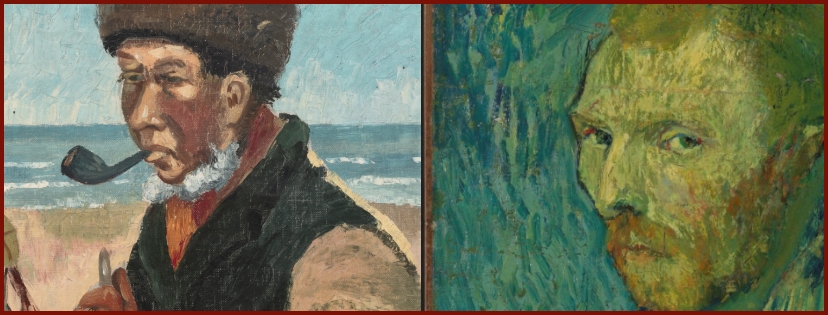
Van Gogh was in an asylum when he apparently painted this work. He spent the last year of his life there, painting close to a hundred fifty works before his tragic death. The self-portrait pictured alongside this contested image are from the same period. Notice the brushwork and the color palette.
Even if we were to accept the picture on the right, we’d have to ask ourselves: What would Van Gogh have seen while in this asylum in the South of France? While artists can and do make changes to the landscapes they paint, certain distinctive features are nevertheless preserved.
Those backing this work as a Van Gogh don’t seem to know precisely what Van Gogh was depicting. Or if they do, they haven’t shared it with us.
Nor can they explain why and how this work ended up in a garage sale in Minnesota.
And while they’re right that Van Gogh used a more muted palette in his later years, the self-portrait above from the same period has a far more vibrant palette as well as more energetic brush strokes than this one.
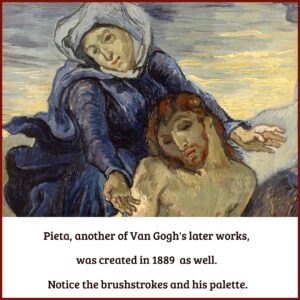
That was one of the first things that caught my eye. There are certain blues and greens and yellows that show up in Van Gogh’s paintings. You can see them in works as diverse as the Pieta above and this field of irises. There’s the same energetic, passionate brushwork.

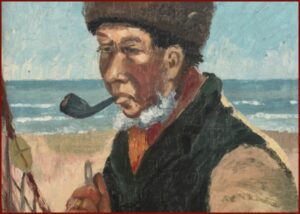
The background in the disputed work is flat and lacks character. The details of the net are vague, not because of the light or weather conditions but because the artist seems to have lacked the technical skill to convey what the eye would see.
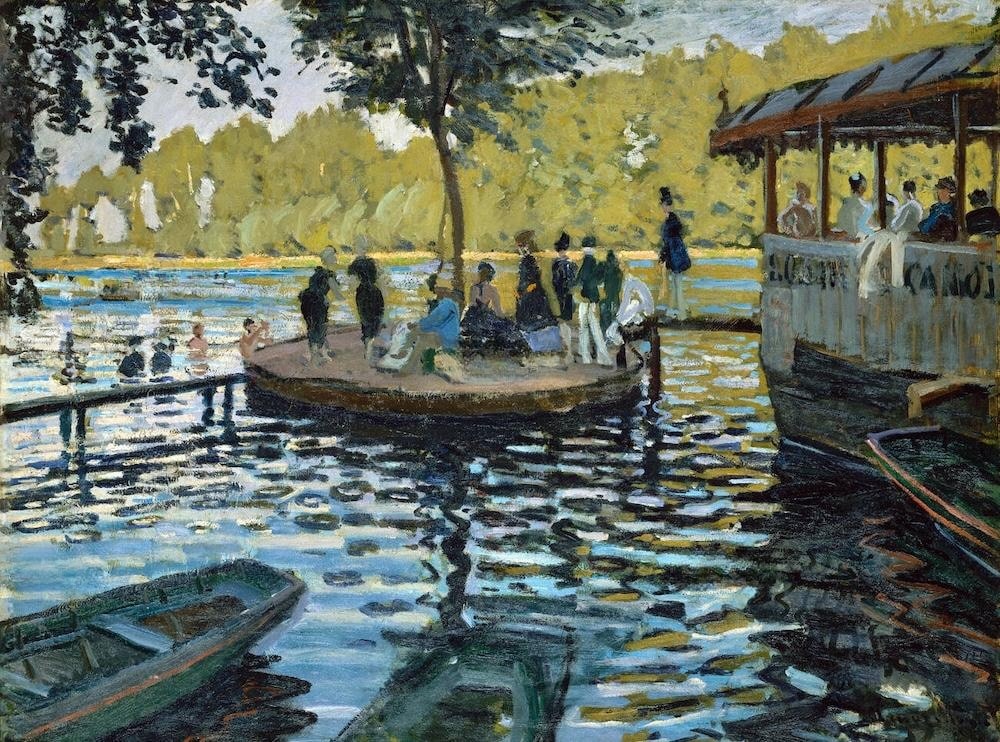
One of the striking features of Impressionist and Post-Impressionist art is how well the artists capture human perception—the lack of clarity, the fuzziness, caused by the viewing angle and the conditions of light. It’s amazing how well what we perceive is broken down into precise areas of color, laid down in a particular way.
One has only to see a photograph and a painting side by side to see how accurate this depiction is. Monet’s La Grenouillère is a perfect example of this.
Then there’s the figure in the foreground of the “Van Gogh”. As a figure drawn from memory, it’s pretty good. But the face lacks character and the figure itself looks stiff and posed—again like something drawn from memory.
And yet look at Van Gogh’s self portrait. Or take a look at the play of light and shade on the work that supposedly influenced him to create this work. Both depict fisherman at work. Yet Michael Ancher portrays a face has depth and character, the body and its pose look authentic, not like a two-dimensional shape painted on a flat surface.
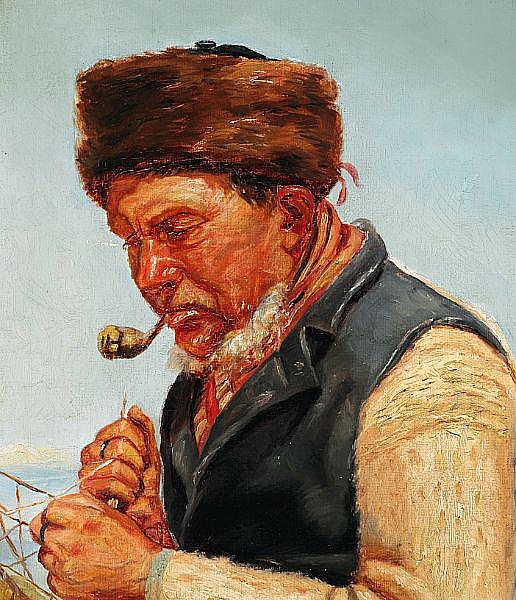
The ability to draw from memory is wonderful. But when we’re relying upon an imperfect memory, our draftsmanship has a stylized quality to it. We find ourselves using familiar icons to represent eyes, for instance, or lips, or human poses.
On the other hand, when we draw from life, we represent more accurately the essential character of the thing we’re trying to depict—whether it’s the human body or an orange.
And that’s why I have my doubts about this supposed Van Gogh.
But whether I’m right or wrong, it’s this kind of debate that finds its way into my art heist mysteries, driving the suspense and making for a more authentic—and more enjoyable—reading experience.