

When I began researching the Gardner Museum theft and, in particular, Vermeer for the Celine Skye Psychic Mysteries, I came across a number of intriguing theories.
One was that the entire art stolen—now worth about half a billion dollars, with Vermeer’s Concert accounting for half the amount—had been destroyed. That, at any rate, was the word on the street.
Yet some years after the theft, a Boston Herald reporter claimed to have been taken to a warehouse to see the stolen Vermeer—then as now, the most valuable piece taken in the heist.
He was able to chip off some paint flakes—and astoundingly enough the pigments matched the ones Vermeer had used.
These details helped me to concoct Master of Illusion, the first Celine Skye Mystery.
But I also wanted to know more about Vermeer. For two reasons.
First, anyone who goes into art recovery must be extremely familiar with various artists’ styles, brush techniques, and the like to make a preliminary assessment of whether any work a criminal contact leads them to is authentic.
The second reason, of course, is that Celine is psychic and receives flashes of insight into past events and future incidents.
I thought it would be fascinating to convey some aspects of Vermeer’s life and technique through Celine’s psychic visions.
Sadly, there wasn’t much about Vermeer. The man was an enigma.
Take The Art of Painting–it’s the featured image on this blog post. The artist in the painting is widely believed to be Vermeer himself. But all we see is the man’s back.
This view from the rear resembles the man seated at the harpsichord in The Concert, the painting stolen from the Gardner Museum in the 1990 heist. But that could just be an illusion. After all, no one makes a positive ID of a suspect based on what they look like from the back!
The little we know about Vermeer is that he was an art dealer in addition to being an artist and lived with his wife’s mother, Maria Thins. What his personality was like, we have no idea.
But that wasn’t the only mystery.
Vermeer’s works and the process he used to create them were as enigmatic as the man. Art historians have long suspected Vermeer used a camera obscura.
One giveaway to that fact is the level of detail you can see in background items like the map of Netherlands in the image below and in The Art of Painting. The other is the size of the figure of the officer in the foreground in relation to that of the woman farther back.
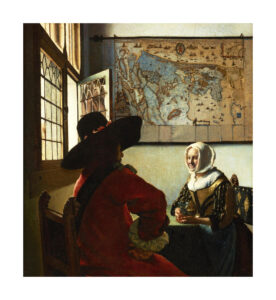
The naked eye wouldn’t perceive a difference between two figures so situated. Only through a camera lens would the figure in the foreground appear significantly larger than the one beyond it.
But there’s another fact that completely astonishes art historians as well. When you examine the paintings with X-ray lighting, the underpaintings show no traces of lines.
How had Vermeer managed to paint without lines?
Unlike other artists, Vermeer’s underpaintings reveal areas of light and shadow. He may, of course, have traced the image onto a sheet of paper and then transferred it to the canvas. But no preliminary drawings or sketches of his works have been found.
So how in the world did he achieve that effect?
Obviously, the fact in itself provides an extremely useful way to distinguish between an authentic and a forged Vermeer. And I planned to use that idea in my novel.
But I wanted to do more!
What if my characters could solve the problem for the reader?
So I researched the issue and came upon one theory that seemed to make sense. It was a method known to artists, commonly used and recommended, and it was absolutely brilliant.
It’s a method that Celine Skye and her friend, former FBI agent, Julia Hood discover in the course of their investigation. I’ll let you read the book to find out what it is:
Also Available in Print and as an Audiobook on Amazon.